Ecosystem
Verax is best understood as shared attestation infrastructure rather than as a single dApp.
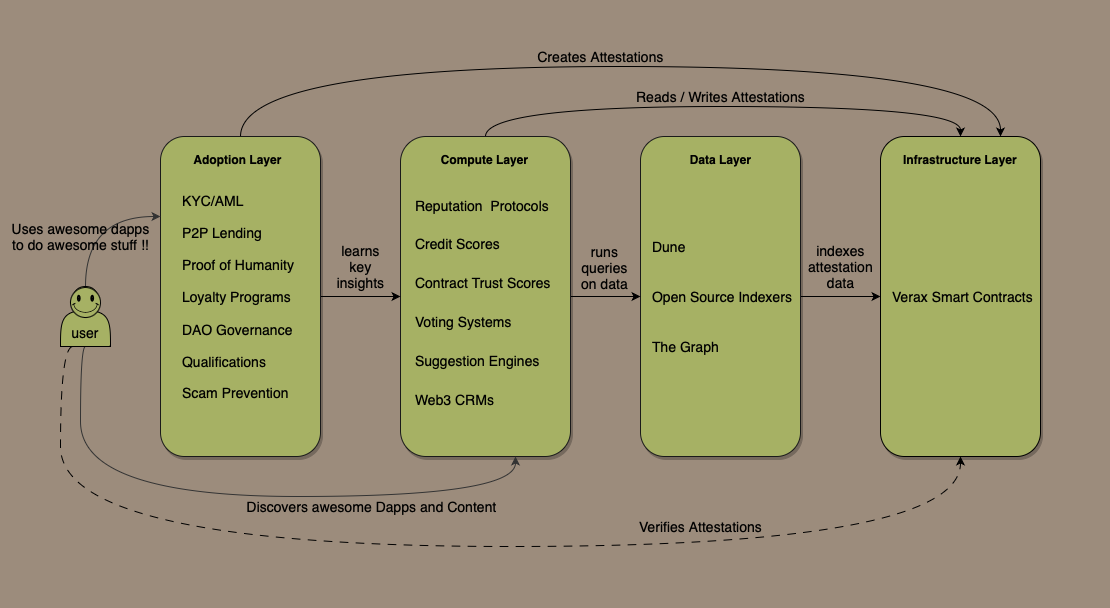
A layered view of the Verax ecosystem: protocol, access, builders, and research/consumption.
Protocol layer
The base layer is the Verax deployment on each supported chain:
- router;
- registries;
- canonical schemas;
- issuer portals;
- reusable modules.
This layer defines how attestations are written and discovered.
Access layer
Developers and researchers usually access Verax through:
- the SDK for application code;
- the subgraph for indexed queries;
- the explorer for human browsing;
- direct contract reads when they need onchain guarantees.
Builder layer
Applications can use Verax in two very different ways:
- as issuers, by publishing attestations through their own portal;
- as consumers, by reading schemas, portals, and attestations created by others.
One of Verax's advantages is that both roles can coexist. A team can issue its own attestations while consuming third party attestations from the same registry.
Research layer
Researchers can use Verax as a shared attestation dataset for:
- issuer behavior analysis;
- schema standardization studies;
- relationship graph analysis;
- trust and provenance experiments;
- cross-chain attestation discovery.
This is where canonical schemas, chain-prefixed IDs, and linked-data conventions become especially important.
Reputation and market structure view
Another useful lens is to think of Verax as shared reputation infrastructure:
- issuers publish claims;
- subjects accumulate or contest attestations;
- consumers and researchers derive meaning from public, queryable state;
- applications turn that shared state into product decisions, discovery, or analytics.
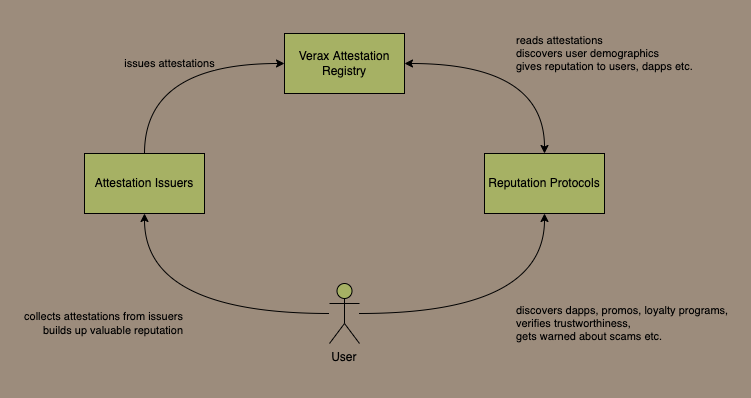
Verax can also be read as a shared reputation and discovery substrate, not only as a contract stack.
Important distinction: protocol data vs editorial surfaces
Some Verax surfaces are protocol-backed and some are editorially curated.
- Registries, SDK reads, and subgraph entities are protocol-backed.
- Parts of the explorer home page and issuer showcase are curated UI data.
That distinction matters for research, analytics, and documentation accuracy.